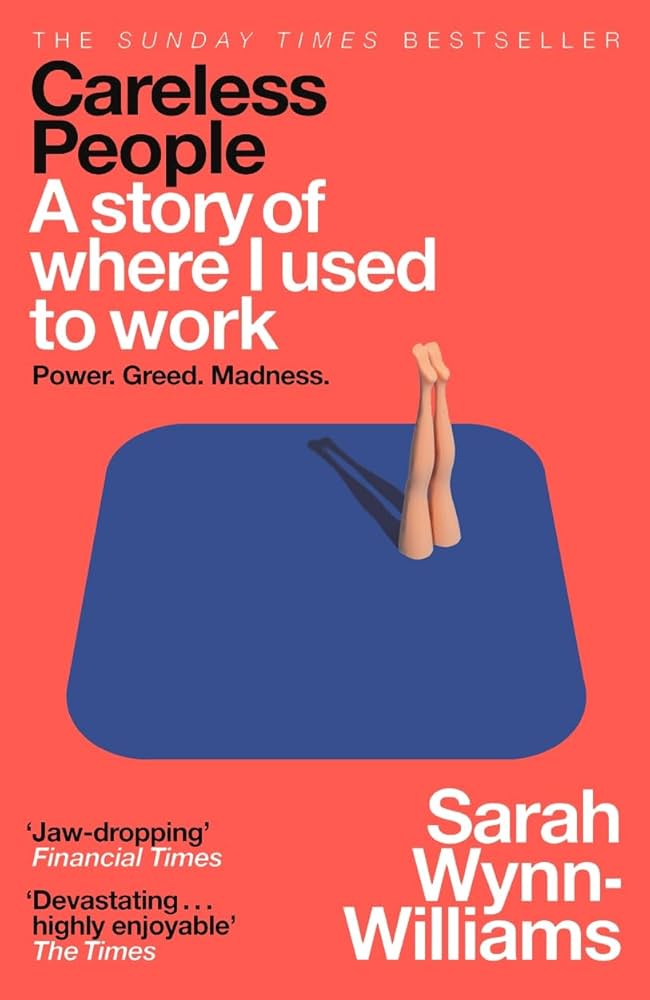
I learned about this book the same way I suspect many people did - from the news stories that Meta won an arbitration order to stop Wynn-Williams from promoting it. Wynn-Williams is a great storyteller, sharing plenty of insider information about Facebook and its executives, from juicy tidbits and surreal experiences to some pretty damning accusations.
The first anecdote opens with her escorting Mark Zuckerberg through a crowd of naked actors somewhere in Panama, having turned up early to the state dinner at the 2015 Summit of the Americas. After determining no-one was particularly interested in talking to Mark, and since he wasn’t that interested in talking to anyone either, they decided to ditch the affair by running out through a herd of oncoming horses and across a dark field. This, she claims, is an apt metaphor for her time at Facebook, which ‘started as a hopeful comedy and ended in darkness and regret’.
Throughout the rest of the book we get equally surreal anecdotes. For example, she hitchhiked her way to the Ministry of Transport and Communications in Myanmar to ask the military junta to turn Facebook back on because the stock price was down and the company’s leaders were desperately looking to boost numbers. Or she was sent to Colombia to convince one of Facebook’s executives to stay, only to find herself in a sweaty salsa club after midnight dancing next to Hillary Clinton.
Alongside her surreal anecdotes is her insider perspective on some major controversies surrounding Facebook, from its role in Myanmar and the election of Donald Trump to its practice of targeting ads to vulnerable teens. The common theme that emerges is that of ignorant executives, especially when it comes to politics and culture outside the US, who are entirely focused on growth, with little apparent interest in engaging with the potential harms the platform is causing, even when those harms are brought to their attention.
But this book contains another story that is just as interesting to me, and that is her story: how she started full of ambition and good intentions that were chipped away little by little. It can be very hard to see from the inside what is obvious from the outside. Her ambition and eagerness to please cloud her judgement, like when she didn’t realise she could say ‘no’ to a plan to send her to South Korea ahead of top executives to see if she would get arrested, because according to their lawyers there was a real possibility of jail or criminal liability in the country.
Her husband suggests to her that she has Stockholm syndrome, and it is easy to see how her relationship with the company resembles an abusive relationship. And as with an abusive relationship, the company supported many aspects of her and her family’s life and used that as leverage. They were sponsoring her so that her family can stay in the US, paying her salary which supported her family financially, controlled her partly unvested shares that backed her mortgage, and provided the healthcare that her family depended on. It is not easy to extricate yourself from that house of cards. And I don’t think her experience is unique to her and Facebook. When permission to stay in the country and healthcare are tied to your job, and you forfeit part of your compensation when you leave, you are trapped. It can be harder still to get out if this coincides with other life events, like illness or having children, which raise the stakes and leave you less room to plan an exit.
As in so many abusive relationships, leaving wasn’t the end of it. Wynn-Williams says she was coerced into signing a severance agreement with a non-disparagement clause because it was a condition for the company reimbursing her for hundreds of thousands of dollars in business expenses she had paid personally and for continuing her healthcare coverage. Once the book was announced in March 2025, Meta won an emergency arbitration injunction to stop her from promoting it, based on that agreement. Over the next year Meta and Wynn-Williams engaged in some talks without resolution. In June 2026, Wynn-Williams filed a complaint in court, repeating the allegations from her book in a legal filing, and detailing actions that Meta has allegedly taken to retaliate against her. The complaint states that Meta made disparaging statements about her that she couldn’t respond to due to the injunction, and that Meta considers it a violation of the order if she promotes the book, but also if she speaks about Meta at all, or appears with critics of the company. The arbitrator even suggested that she couldn’t talk to US and EU lawmakers in private, because they might repeat some of the book’s claims in public. She claims she has had to decline hundreds of speaking engagements and book events, and that it has hindered her employment opportunities as a public policy expert. She accuses Meta of monitoring her actions, and says she has to live with the threat of large financial penalties for not complying with this broad and ambiguous order.
Meta has made comments about her and the book in the media, calling the book ‘false and defamatory’, and publishing a ‘fact-check’, in which they cover seven claims, saying all were previously known and disputing three. However, they have not taken any steps that would test the claims in court, and the injunction was based on the non-disparagement clause in the severance agreement, not on whether the claims were true or false. The court has denied her request to cancel the injunction and sent her back to arbitration, saying she had left it too late and waived her right to object to arbitration by participating in the preceding months.
While the allegations haven’t been adjudicated yet, Meta’s response certainly does not make the company look good. And even if you don’t believe Wynn-Williams’ allegations (for the record, I do), that doesn’t negate how much power and control companies can gain over their employees, and that should make us uncomfortable.